IPv6 Explained: Why It Matters and How to Transition
IPv6 Explained: Why It Matters and How to Transition
The rapid growth of the internet has pushed IPv4 to its limits. IPv6 is the next-generation protocol designed to solve the address shortage once and for all. In this guide, we explore why IPv6 is necessary, how it compares to IPv4, and how the global transition is progressing.
IPv4 Exhaustion: Why IPv6 Is Necessary
IPv4 provides roughly 4.3 billion addresses, but IANA allocated the last available blocks back in 2011. The explosion of smartphones, IoT devices, and cloud infrastructure has far outpaced what the original address space can support. NAT (Network Address Translation) has served as a stopgap, but it complicates peer-to-peer communication and adds architectural overhead. IPv6 is the only sustainable, long-term solution to this fundamental problem.
IPv6 Address Structure at a Glance
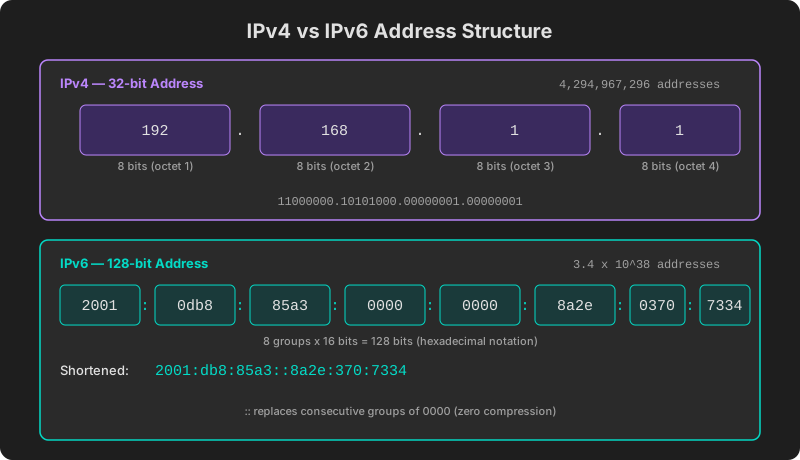
An IPv6 address is 128 bits long, providing approximately 3.4 x 10^38 possible addresses. It is written as eight groups of four hexadecimal digits separated by colons.
2001:0db8:85a3:0000:0000:8a2e:0370:7334Leading zeros can be dropped within each group, and a single consecutive run of all-zero groups can be compressed to ::. For a more detailed explanation of IP address structure, see the Complete Guide to IP Addresses.
IPv4 vs IPv6 Comparison
| Feature | IPv4 | IPv6 |
|---|---|---|
| Address length | 32 bits (~4.3 billion) | 128 bits (~3.4 x 10^38) |
| Notation | Dotted decimal (192.168.1.1) | Colon-separated hex (2001:db8::1) |
| Header size | Variable (20–60 bytes) | Fixed (40 bytes) |
| NAT requirement | Essential due to address scarcity | Unnecessary (public address for every device) |
| Security | IPsec optional | IPsec built-in |
| Auto-configuration | Relies on DHCP | Native SLAAC support |
| Broadcast | Supported | Replaced by multicast |
Transition Technologies: Dual Stack, Tunneling, and NAT64
The shift from IPv4 to IPv6 cannot happen overnight. Several transition mechanisms allow both protocols to coexist during the migration period.
Dual Stack runs IPv4 and IPv6 simultaneously on the same device. It is the most straightforward approach and offers the best compatibility, though it requires maintaining two protocol stacks in parallel.
Tunneling encapsulates IPv6 packets inside IPv4 packets so they can traverse IPv4-only networks. Well-known techniques include 6to4, Teredo, and ISATAP. Tunneling lets organizations leverage existing IPv4 infrastructure while gradually adopting IPv6.
NAT64/DNS64 translates between IPv6 and IPv4, enabling IPv6-only clients to reach IPv4-only services. This mechanism plays a critical role in the final stages of the transition, preserving backward compatibility as networks go IPv6-only.
Global IPv6 Adoption
According to Google’s statistics, worldwide IPv6 adoption has surpassed roughly 45%, with countries like India, the United States, and Germany exceeding 50%. South Korea, by contrast, has been slower to adopt, though major ISPs are gradually expanding IPv6 support. Globally, mobile networks are leading the transition, adopting IPv6 faster than fixed-line broadband.
How to Check If Your Connection Uses IPv6
Wondering whether your internet connection is running on IPv6? Visit ip.utilo.kr to find out instantly. The site displays your current IP address and tells you whether it is IPv4 or IPv6, along with ISP details and geolocation data.
For more on the distinction between public and private addresses, see Public vs Private IP: Differences and How to Check.