IP Geolocation Accuracy: How Precise Is It Really?
IP Geolocation Accuracy: How Precise Is It Really?
You’ve probably visited a website that greeted you with “It looks like you’re in Seoul” or offered to show prices in your local currency. This is IP geolocation at work — mapping your IP address to a physical location. But how accurate is it, really? The answer depends heavily on what level of detail you’re looking at.
How GeoIP Databases Work
IP geolocation doesn’t use GPS or any real-time positioning system. Instead, it relies on database mapping — precomputed tables that associate IP address ranges with geographic locations.
Data Collection Methods
GeoIP providers build their databases from multiple sources:
- IP allocation records: IANA and Regional Internet Registries (RIRs) like APNIC, RIPE, and ARIN publish which IP blocks are assigned to which organizations and countries.
- ISP registration data: WHOIS records contain address information registered by ISPs.
- Network measurements: Techniques like traceroute analysis and latency triangulation help estimate the physical location of IP endpoints.
- Crowdsourced data: GPS-enabled mobile apps, Wi-Fi hotspot databases, and user-submitted corrections refine location mappings.
- Known infrastructure: Data centers, corporate headquarters, and university networks have well-documented locations.
These sources are combined to produce mapping tables:
203.0.113.0/24  →  South Korea, Seoul, Gangnam-gu
198.51.100.0/24 →  United States, California, San Francisco
Accuracy by Granularity Level
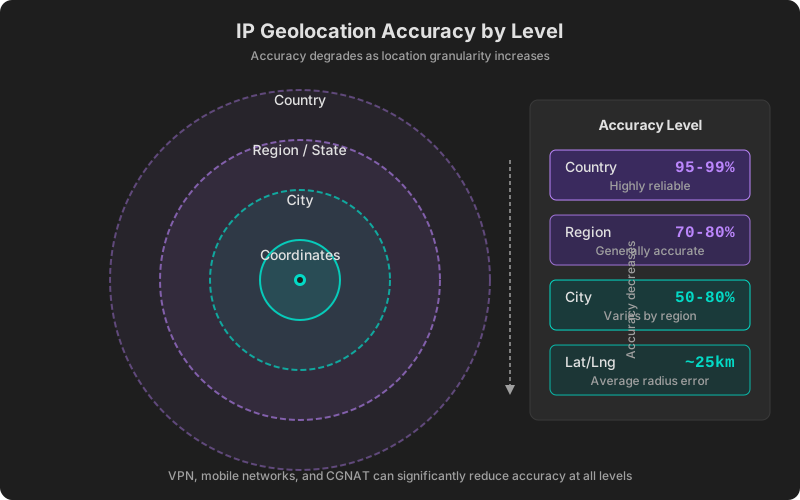
The accuracy of IP geolocation varies dramatically depending on the level of detail.
Country Level: 95-99% Accurate
This is the most reliable level. IP address blocks are allocated by country, so determining which nation an IP belongs to is straightforward. Most commercial GeoIP databases achieve 99%+ country-level accuracy for standard ISP connections.
| Condition | Accuracy |
|---|---|
| Residential ISP | 99% |
| Corporate/datacenter | 97-99% |
| Mobile network | 95-98% |
| VPN/proxy in use | Unreliable |
Region/State Level: 70-80% Accurate
At the state or province level, accuracy drops noticeably. ISPs often assign IP blocks across broad geographic areas. A user in Suwon (Gyeonggi Province) might show up as being in Seoul because their ISP routes traffic through a Seoul gateway.
City Level: 50-80% Accurate
City-level accuracy has the widest variance:
- Major metros: 70-80% (New York, London, Tokyo — cities with major ISP presence)
- Mid-size cities: 50-60% (often mapped to the nearest ISP hub)
- Rural areas: 30-50% (typically defaults to the nearest city center)
A study by MaxMind found their GeoLite2 database correctly identifies the city within 50km for about 67% of IP addresses in the United States.
Coordinate Level: ~25km Average Error
Latitude and longitude coordinates from GeoIP databases should be treated with extreme caution. In most cases, the coordinates point to the geographic center of the identified city, not the user’s actual location.
GeoIP coordinates: 37.5665°N, 126.9780°E (Seoul City Hall area)
Actual location:   37.4979°N, 127.0276°E (Gangnam Station area)
→ Straight-line distance: ~8.5km difference
In practice, errors of 25-50km are common, and in rural areas the error can exceed 100km.
Factors That Affect Accuracy
VPNs and Proxies
When a VPN is active, GeoIP returns the VPN server’s location, not the user’s. Someone in Seoul connecting through a US VPN server will appear to be in the United States. This is a fundamental limitation of IP-based geolocation. For more on this topic, see our guide on VPN detection methods.
Mobile Networks
Mobile carriers allocate IP addresses dynamically across wide geographic regions. A user on LTE in Busan might be assigned an IP that routes through a gateway in Daejeon. Mobile IP geolocation is consistently less accurate than fixed broadband.
CGNAT (Carrier-Grade NAT)
With CGNAT, thousands of users share a single public IP address. The GeoIP database can only map to the NAT gateway’s location, which might be in an entirely different city from many of the users behind it.
Corporate Networks
Large enterprises route all traffic through headquarters or centralized VPN concentrators. An employee in a branch office in Chicago might show an IP located at the corporate HQ in New York.
IP Reassignment
When IP blocks are transferred between ISPs or organizations, GeoIP databases take time to update — typically days to weeks. During this gap, queries return the old location data.
Major GeoIP Database Providers
MaxMind GeoIP2
The industry standard. Offers both free (GeoLite2) and commercial (GeoIP2) databases.
- Country accuracy: 99.8%
- City accuracy: ~67% within 50km
- Update frequency: Twice weekly
DB-IP
A growing alternative to MaxMind with competitive accuracy.
- Free tier available
- Similar city-level accuracy to MaxMind
- API-based real-time lookups
IPinfo
Developer-friendly API with clean documentation.
- Simple REST API
- Includes ASN, company, and privacy detection data
- 50,000 free monthly lookups
IP2Location
Particularly strong in Asian markets.
- High accuracy for South Korea, Japan, and Southeast Asia
- Multiple database tiers
- Offline database support
Limitations and Common Misconceptions
The TV Drama Myth
Crime shows love the trope of “We traced the IP to apartment 4B on the third floor.” In reality, this is impossible with GeoIP alone. IP geolocation can only provide a rough city-level estimate. To get a subscriber’s physical address, law enforcement must serve a legal order to the ISP — GeoIP databases simply don’t have that precision.
IP Location ≠ User Location
IP geolocation reflects the location of network infrastructure — ISP gateways, NAT devices, VPN servers — not necessarily where the human user is sitting. This distinction is critical for any application relying on IP location data.
Accuracy Varies by Region
Developed countries with well-documented ISP infrastructure tend to have much better GeoIP accuracy than developing regions.
| Region | City-Level Accuracy |
|---|---|
| US/Europe major cities | 70-85% |
| South Korea/Japan | 75-85% |
| Southeast Asia | 40-60% |
| Africa | 20-40% |
When You Can Trust GeoIP
- Content regionalization: Country-level content serving (Netflix, etc.)
- Ad targeting: Approximate regional ad delivery
- Analytics: Visitor country/region statistics
- Basic security: Flagging logins from unexpected countries
When You Should Not Trust GeoIP
- Precise address lookup: Anything below city level
- Legal evidence: Location proof for legal proceedings
- Individual identification: Pinpointing a specific person’s location
Check Your IP Location
Curious about what GeoIP databases think about your location? Head to ip.utilo.kr to see your IP’s mapped country, city, and coordinates for free. Compare the result with your actual location to see how accurate — or inaccurate — the mapping is.
If you’re using a VPN, try our VPN detection tool to see whether your VPN usage is detectable.
Related posts: VPN Detection Methods | Complete Guide to IP Addresses